


🌊 Emotional Regulation: From Meltdowns to Calm
Price
Free
Duration
5 Days
About the Course
A free five-day email course designed to help your child navigate big feelings with greater confidence. Through five short lessons, you'll discover what lies beneath meltdowns and emotional overwhelm, learn practical ways to support regulation, and build calmer, more connected responses that strengthen your relationship and help your child thrive.
Five-Day From Chaos To Calm Email Course
To accompany the From Chaos To Calm - Webinar and Starter Pack.
Your Instructor
Dr Harry Woodward

Dr Harry Woodward, Consultant Paediatrician, Medical Director NeuroDiverse Kids
Subject: Day 1 of 5 — Recognising and naming big feelings Preview text: Why up to half of autistic people struggle to know what they're feeling, and what actually helps
Hi [First name],
Welcome to the Emotional Regulation Confidence course. Over the next five days I'll walk you through the Emotional Regulation Starter Pack, one manageable piece at a time, so you can start supporting your child's big feelings with more confidence and a lot less guesswork.
Today we start with the foundation: helping your child recognise and name what they're feeling.
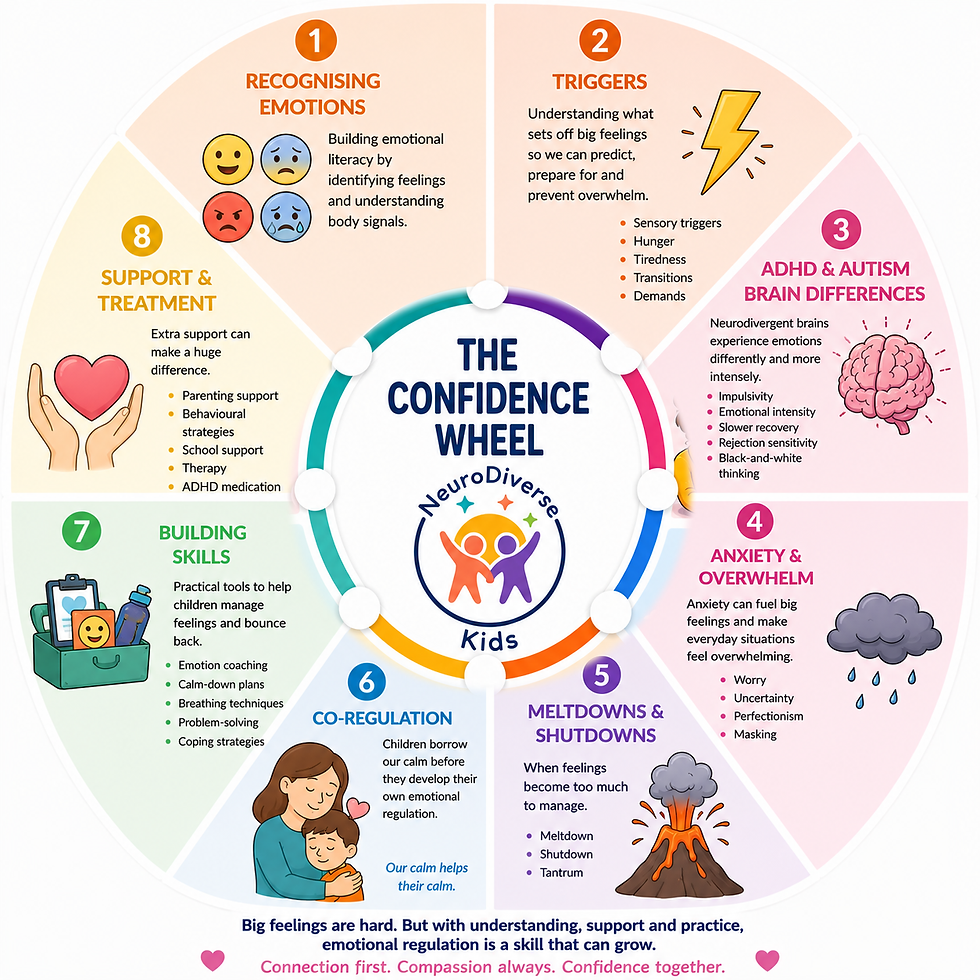
The Emotional Regulation Confidence Wheel
Emotional regulation difficulties rarely have a single cause. I map eight areas that commonly affect how neurodivergent children manage big emotions:
Understanding Emotions
Feelings Vocabulary
Triggers & Patterns
Meltdowns & Shutdowns
Co-Regulation
Sensory Regulation
Environment & Demands
Professional Support
Look at all eight and notice which one resonates most with your family right now. Start there, and only there. Small, consistent changes in one area ripple outward into the others.
Why naming emotions is harder than it looks
Many neurodivergent children, particularly those with alexithymia, struggle to identify what they're feeling. Around 50% of autistic people experience alexithymia, difficulty identifying and describing their own emotional states. This isn't a lack of emotion, it's difficulty reading the internal signals that tell us what we're feeling. Naming emotions out loud for your child ("You look like you might be feeling frustrated right now") is a powerful support strategy.
Give feelings a body, not just a word
Instead of asking "How do you feel?" (too vague for many ND children), try "Where do you feel it in your body?" or offer two options: "Does it feel more like butterflies, or more like a heavy feeling?" A few common patterns:
Angry: face hot and red, fists or jaw clenched, heart racing, body hot all over.
Anxious: butterflies or a sick feeling in the tummy, racing heart, cold sweaty hands, tight or dry throat.
Overwhelmed: body feels heavy or frozen, sounds feel louder, light feels brighter, brain feels foggy or blank.
Reducing the cognitive load of emotion identification makes a real difference.
Today's action step
Start building emotional vocabulary this week:
Narrate emotions out loud throughout the day, yours, theirs, characters in books and TV: "He looks really disappointed, doesn't he?"
Try "emotion of the day" at dinner, each person shares one feeling they had and what caused it.
Avoid dismissing feelings ("You're fine") in favour of validating them ("That sounds really frustrating").
Start tonight: at bedtime, ask "What was one feeling you had today?" No pressure to elaborate, just naming it is enough to start building the habit.
Tomorrow: why your child's brain reacts the way it does, and what that means for how you respond.
Warmly, Dr Harry Woodward NeuroDiverseKids
P.S. Want to see the whole five-day plan right now instead of waiting for each email? Read it all here: [link to course webpage]
Subject: Day 2 of 5 — Why your child's brain reacts this way Preview text: Emotional intensity, rejection sensitivity, and the worry thermometer
Hi [First name],
Yesterday we looked at recognising and naming feelings. Today is about understanding why neurodivergent brains experience emotions differently, and often more intensely, so you can respond with compassion rather than confusion.
ADHD and autistic brains feel emotions differently
Emotional intensity: neurodivergent children often feel emotions at full volume. What feels like a "small" frustration to others can genuinely feel catastrophic to them. This isn't drama, it's neurology.
Slower emotional recovery: the nervous system takes longer to return to baseline after a big feeling. What looks like "still being upset about it" is a real physiological process, not stubbornness or manipulation.
Impulsivity: the gap between feeling and action is much smaller. The thinking brain is slower to apply the brakes, which is why "just stop and think" doesn't work, the impulse has already landed.
Rejection sensitivity: many ADHD and autistic children experience rejection sensitivity dysphoria (RSD), an intense emotional response to perceived criticism, failure, or rejection. A mild correction can feel devastating.
Black-and-white thinking: situations are often experienced as all-good or all-bad. Shades of grey are genuinely hard to perceive. A small mistake can feel like complete failure.
What this means for you: your child is not choosing these reactions. They need regulation support from outside, co-regulation, structure, sensory support, until their own systems mature. Knowing this changes everything.
Remember: a neurodivergent brain experiencing big emotions is not failing, it is doing exactly what it was built to do. Our job is to build the scaffolding around it until it can hold itself up.
Anxiety and overwhelm
For neurodivergent children, anxiety is often a constant background hum, not a phase, but a feature that needs understanding and support.
Common signs: worry about things most children wouldn't notice, a rigid need for sameness and predictability, perfectionism, masking (hiding anxiety at school, then releasing it at home), somatic symptoms like headaches or stomach aches with no medical cause, and school avoidance or refusal.
What helps: validate first ("That does sound scary") before problem-solving, preview and prepare with as much advance notice as possible, reduce uncertainty with visual schedules and social stories, don't avoid everything (gentle, gradual exposure maintains function), watch for masking (if school is fine but home is chaos, ask what they're holding in), and use breathwork and body tools, anxiety lives in the body, so regulate the body first.
Today's action step
Try the anxiety temperature check tonight. Ask: "Where are you on the worry thermometer today?" 1–2 calm, 3–4 a bit worried, 5–6 anxious, 7–8 very worried, 9–10 overwhelmed. Using this daily helps your child build the habit of self-monitoring.
Tomorrow: becoming a trigger detective, and stopping big feelings before they start.
Warmly, Dr Harry Woodward NeuroDiverseKids
P.S. Full spoke here: [link to course webpage]
Subject: Day 3 of 5 — Becoming a trigger detective Preview text: The six categories of triggers, and the after-school danger zone
Hi [First name],
A trigger is anything, internal or external, that pushes a child past their window of tolerance. Identifying your child's triggers is detective work: patient, curious observation over time. Today is about spotting patterns, and reducing triggers before they happen.
Six common trigger categories
Sensory: loud or sudden noise, bright or flickering light, crowded spaces, uncomfortable clothing, food texture or smell, physical touch.
Social: conflict with peers, being misunderstood, group work, unpredictable people, being teased or left out, social expectations.
Demands: too many instructions at once, unexpected tasks, work that feels too hard, being told "no", homework, getting dressed or ready.
Transitions: stopping a preferred activity, changing plans without warning, moving between locations, end of school day, routine changes, surprises.
Internal: hunger or thirst, tiredness or poor sleep, illness or pain, anxiety or worry, excitement build-up, stress accumulation.
Environment: home atmosphere or tension, messy or unpredictable space, screen time ending, unfamiliar places, new people, changes to objects or space.
Start a trigger log
After any significant emotional episode, note down: what happened just before, the trigger category, what helped, and what made it worse. After 5–10 entries, look for patterns: is there a time of day? A day of the week? A particular setting? A physical state, hungry, tired? Patterns unlock prevention, which is always better than intervention.
ND note: many neurodivergent children experience "cumulative triggering", one small thing alone would be manageable, but three small things in a row tip them over. What looks like an overreaction to the last thing is actually a response to everything that came before it.
Reducing triggers proactively
Preview transitions: give 5- and 2-minute warnings before any activity change. Use visual timers for children who struggle with time concepts.
Reduce demand stacking: don't pile instructions, give one at a time, and wait for compliance before the next.
Sensory audit: walk through your child's day and identify sensory pinch points (loud assemblies, crowded corridors, fluorescent lights), and reduce where possible.
Build in decompression time: after school is a high-risk period. Many ND children hold it together all day and explode at home. Protect the first 30–60 minutes after school: no demands, no questions, no chores.
Watch hunger and tiredness: these are the triggers that enable all other triggers. Prioritise nutrition and sleep as your baseline intervention.
ND note: Demand Avoidance Profiles (PDA) are common in autistic children. If your child seems to resist all demands, even pleasurable ones, it's worth learning about Pathological Demand Avoidance and seeking specialist support. Standard behavioural approaches are often counterproductive here.
Today's action step
Start your child's trigger log this week. Even a handful of entries will start to show you a pattern.
Tomorrow: what actually happens during a meltdown or shutdown, and what to do (and not do) in the moment.
Warmly, Dr Harry Woodward NeuroDiverseKids
P.S. Full spoke here: [link to course webpage]
Subject: Day 4 of 5 — Meltdowns, shutdowns, and what to do in the moment Preview text: "Connection before correction", and the toolkit worth building before you need it
Hi [First name],
Meltdowns and shutdowns are not tantrums. They are involuntary responses to neurological overwhelm. Understanding this changes everything about how we respond.
Meltdown vs. shutdown
A meltdown is an outward explosion of overwhelm: crying, screaming, hitting, throwing. It's hard to miss, and your child is usually visibly distressed and frightened. A shutdown is an inward collapse or withdrawal: going very quiet, freezing, not responding. It's often missed, mistaken for "being fine", but your child is equally distressed, just unable to show it. Both need time, space and calm presence to recover; shutdowns especially need quiet and no demands.
The three stages
Before, the rumble phase: watch for increased fidgeting or stimming, voice changing pitch, repetitive questioning, becoming rigid or inflexible, withdrawal, hypersensitivity to small things, or pacing and rocking. This is the moment to act, a calm, low-demand intervention here can prevent escalation entirely.
During, the crisis phase: stay calm (your nervous system regulates theirs), ensure physical safety, reduce demands to zero, speak less not more, and offer presence without pressure. Don't reason or problem-solve, don't threaten consequences, don't involve more adults, and don't demand eye contact.
After, the recovery phase: allow as much time as needed, offer water, food or a blanket, keep the environment quiet and familiar, don't debrief immediately, offer physical closeness if wanted, and wait hours or even days before discussing what happened. Post-meltdown shame is real, children often feel deeply ashamed. Lead with compassion, not consequence.
Important: if meltdowns are happening daily, lasting over 30 minutes, or involve significant risk of injury, this warrants professional support. You do not have to manage this alone.
ND note: many autistic children experience "autistic burnout", a period of significantly reduced capacity following prolonged masking or stress. This can look like a dramatic regression in skills, extreme shutdown, and emotional flatness. It's different from depression and needs a different response: rest, reduction in demands, and time, not pushing through.
What actually helps in the moment
Regulate yourself first: one slow breath out, lower your shoulders, drop your voice. This is not optional, it is the intervention.
Remove the audience: other children or adults watching amplifies shame and dysregulation. Create space and privacy where possible.
Say less: every additional word during a meltdown raises arousal. "I'm here. You're safe." is often enough.
Offer, don't instruct: "Would you like a blanket?" not "Go to your room." Offering choice restores a sense of control, which is often what was lost.
Don't take it personally: things said during a meltdown aren't deliberate, they're the overflow of a flooded nervous system. Respond to the distress, not the words.
Safety check only: during a meltdown, your only job is safety and presence. Consequences, conversations and lessons come later, when both nervous systems are back online.
The phrase to remember: "Connection before correction." Repair the relationship first, everything else follows from there.
Build your toolkit before you need it
Calm corner: a designated calm space at home, not a punishment corner, a genuine retreat. Soft lighting, comfort items, sensory tools. Introduce it when your child is calm.
Sensory toolkit: a small box of items that help regulate your child, fidget tools, stress balls, a chewing necklace, headphones, scented items, textured objects.
Movement breaks: build regular movement into the day. Proprioceptive input, heavy work, carrying, pushing, pulling, is deeply regulating for many ND children.
Breathing tools: practise 4-7-8 breathing, box breathing, or blowing bubbles during calm moments. They need to be familiar before they're needed.
Cold water: splashing cold water on the face activates the dive reflex and rapidly slows heart rate. Genuinely effective and underused.
Weighted items: weighted blankets, lap pads or vests provide calming proprioceptive input for many children. Try before you buy, not every child benefits.
ND note: regulation tools must be introduced and practised during calm times. A child who has never used a breathing technique when calm will not suddenly use one during a meltdown. The toolkit needs rehearsal, not just availability.
Today's action step
Pick one or two toolkit items to introduce this week, while your child is calm, so they're ready when needed.
Tomorrow, the final email: co-regulation, building your child's Calm Plan, and getting school and yourself the support you both need too.
Warmly, Dr Harry Woodward NeuroDiverseKids
P.S. Full spoke here: [link to course webpage]
Subject: Day 5 of 5 — Co-regulation, the Calm Plan, and looking after yourself too Preview text: You cannot pour from an empty cup, here's what to do instead
Hi [First name],
This is the final email in the course, thank you for spending this week with me. Today we bring it together: how to co-regulate in the moment, how to build a Calm Plan with your child, and how to get school and yourself the support you both need.
The co-regulation cheat sheet
Co-regulation is the process of an adult using their own calm nervous system to help a child regulate theirs. Children cannot self-regulate before they've experienced hundreds of episodes of co-regulation. It is not a shortcut, it is the foundation.
You first: co-regulation only works if you are regulated. You cannot pour from an empty cup, and you cannot regulate your child from a dysregulated nervous system. Before you respond to a dysregulated child, take one breath, check your own body, lower your shoulders, soften your voice.
Voice: lower your pitch and slow your pace. A calm, quiet voice is one of the most powerful nervous system regulators available.
Physical presence: get down to their level, sit beside them not in front of them. Proximity without demand signals safety.
Breathe together: take slow, visible breaths yourself. Don't ask them to breathe, just model it, the mirror neurons will do the work.
Less language: when a child is dysregulated, language processing drops significantly. Use fewer words: "I'm here." "You're safe." "Take your time."
Touch, if welcome: firm, predictable touch (a hand on the shoulder, a hug) can rapidly down-regulate the nervous system for children who tolerate it. Always check first, for some ND children touch during dysregulation makes things worse.
Wait it out: a nervous system in fight-or-flight takes 20–40 minutes to return to baseline, even after the trigger is removed. Don't rush recovery.
Routine & rhythm: rhythmic movement (rocking, walking, bouncing) is deeply regulating. Structure is not restrictive, it is regulating.
Sensory anchors: help your child identify two or three sensory experiences that reliably calm them, a weighted blanket, cold water, a specific texture, smell or sound.
The long game: every time you co-regulate with your child, you are laying down the neural pathways they will eventually use to self-regulate. It feels slow. It is not. You are literally building their brain.
Build a Calm Plan together
A Calm Plan is a personalised document that captures what your child needs when emotions become overwhelming, created before a crisis, not during one. Complete it together with your child when they're calm and regulated. Cover: their early warning signs (ask "What does your body do when you're starting to get upset, before the big feelings arrive?"), their biggest triggers, what helps them feel calm again, what does not help (please don't do these when overwhelmed), their safe space, and what they need you to say.
ND tip: revisit and update this plan every few months, children change, and what helps at age seven may not work at age ten. Share a copy with school so they have it available too.
Working with school
Share your child's Calm Plan with their teacher and SENCO. Schools cannot implement what they don't know.
Request that your child has access to a safe space or regulated adult they can go to when overwhelmed, not as punishment, but as support.
Ask about transition support: warning systems before lesson changes, reduced corridor noise exposure, early exit from assemblies.
If your child is masking all day and exploding at home, this is a sign of significant stress. The home is their safe place, the explosion is not the problem, the school stress is.
Consider an EHCP (Education, Health and Care Plan) if needs are significant. This provides legal protection and mandated support.
Key phrase for school meetings: "My child is not choosing to be difficult. They are finding it difficult. What support can we put in place together?"
Looking after yourself
Parenting a neurodivergent child is genuinely hard. Acknowledging that is not self-pity, it is accuracy. Your regulation matters, your child's nervous system co-regulates with yours, so taking care of yourself is taking care of them. Find your community, other parents of neurodivergent children who get it without explanation, online and in-person groups exist and are invaluable. Repair is powerful, you will get it wrong sometimes, and repairing with your child ("I'm sorry I shouted, that wasn't helpful") models the emotional regulation you want them to learn. And seek your own support if needed, therapy, coaching, or a trusted professional. You matter in this equation.
A final word: you are not failing because this is hard. You are not a bad parent because your child dysregulates. You are a caring parent trying to understand a complex child in a world that wasn't built for them. That matters, more than you know.
Thank you for spending this week with me. If you'd like more personalised support, you're welcome to message me or book a consultation.
Warmly, Dr Harry Woodward NeuroDiverseKids
Book a consultation: [link] | Message on WhatsApp: [link] | Visit neurodiversekids.co.uk: [link]